
The clumping of proteins is at the root of a wide range of neurodegenerative disorders that affect the brain such as Alzheimer's and dementia.
May 23 2024University of Copenhagen - Faculty of Science The clumping of proteins is at the root of a wide range of neurodegenerative disorders that affect the brain such as Alzheimer's and dementia. Research ers at the University of Copenhagen have developed a new tool that can help find and study these tiny protein clumps.
The results pave the way for a greater understanding of the body's smallest building blocks and better treatment of diseases like cancer, Alzheimer's and Parkinson's. Nearly 100,000 Danes over the age of 65 and more than 55 million people around the world live with dementia-related disorders such as Alzheimer's and Parkinson's. These diseases arise when some of the smallest building blocks in the body clump together and destroy vital functions. Why this occurs and how to treat it remains a scientific mystery. Until now, studying the phenomenon has been very challenging and limited due to an absence of the right tools. Now, researchers from the Hatzakis lab at the University of Copenhagen's Department of Chemistry have invented a machine learning algorithm that can track clumping under the microscope in real-time. The algorithm can automatically map and track the important characteristics of the clumped-up building blocks that cause Alzheimer's and other neurodegenerative disorders. Until now, doing so has been impossible. "In just minutes, our algorithm solves a challenge that would take researchers several weeks. That it will now be easier to study microscopic images of clumping proteins will hopefully contribute to our knowledge, and in the long term, lead to new therapies for neurodegenerative brain disorders," says PhD Jacob Kæstel-Hansen from the Department of Chemistry, who, alongside Nikos Hatzakis, led the research team behind the algorithm.Microscopic proteins detected in no time The coming together and exchange of compounds and signals among proteins and other molecules occurs billions of times within our cells in natural processes that allow our bodies function. But when errors occur, proteins can clump together in ways that interfere with their ability to work as intended. Among other things, this can lead to neurodegenerative disorders in the brain and cancer. The researchers' machine learning algorithm can spot protein clumps down to a billionth of a meter in microscopy images. At the same time, the algorithm can count and then group clumps according to their shapes and sizes, all while tracking their development over time. The appearance of clumps can have a major impact on their function and how they behave in the body, for better or worse. When studying clumps through a microscope, one quickly sees, for example, that some are rounder, while others have filamentous structures. And, their exact shape can vary depending on the disorder they trigger. But to sit and count them manually many thousands of times takes a very long time, which could be better spent on other things." In the future, the algorithm will make it much easier to learn more about why clumps form so that we can develop new drugs and therapies to combat these disorders. "The fundamental understanding of these clumps depends on us being able to see, track and quantify them, and describe what they look like over time. No other methods can currently do so automatically and as effectively," he says. Tools are freely available to everyone The Department of Chemistry researchers are in now in full swing using the tool to conduct experiments with insulin molecules. As insulin molecules clump, their ability to regulate our blood sugar weakens. Related Stories"We see this undesirable clumping in insulin molecules as well. Our new tool can let us see how these clumps are affected by whatever compounds we add. In this way, the model can help us work towards understanding how to potentially stop or transform them into less dangerous or more stable clumps," explains Jacob Kæstel-Hansen. Thus, the researchers see great potential in being able to use the tool to develop new drugs once the microscopic building blocks have been clearly identified. The researchers hope that their work will kickstart the gathering of more comprehensive knowledge about the shapes and functions of proteins and molecules. "As other researchers around the world begin to deploy the tool, it will help create a large library of molecule and protein structures related to various disorders and biology in general. This will allow us to better understand diseases and try to stop them," concludes Nikos Hatzakis from the Department of Chemistry. The algorithm is freely available on the internet as open source and can be used by scientific researchers and anyone else working to understand the clumping of proteins and other molecules. The research was conducted by: Steen W.B. Bender, Marcus W. Dreisler, Min Zhang, Jacob Kæstel-Hansen and Nikos S. Hatzakis from the Department of Chemistry with support from the Novo Nordisk Foundation Center for Optimised Oligo Escape and Control of Disease.Journal reference:Bender, S. W. B., et al. . SEMORE: SEgmentation and MORphological fingErprinting by machine learning automates super-resolution data analysis. Nature Communications. doi.org/10.1038/s41467-024-46106-0.
Brain Drugs Insulin Machine Learning Microscope Protein Research
United Kingdom Latest News, United Kingdom Headlines
Similar News:You can also read news stories similar to this one that we have collected from other news sources.
 Scientists discover genetic trait that almost GUARANTEES a person will get Alzheimer's and almost 2%...Different diseases such as Alzheimer's affect different parts of the brain and lead to dementia - a loss of cognitive functioning to such an extent that it interferes with a person's daily life and activities.
Read more »
 APOE4 gene linked to early onset Alzheimer's, target for therapeutic interventionA study published in Nature Medicine delineates how APOE4 homozygosity distinctly accelerates Alzheimer's disease pathology and biomarkers from the age of 55, suggesting a unique form of the disease and a potential focus for targeted therapies.
Read more »
 Dementia is having an enormous impact on families that’s why I’ll be proudly displaying my support for Alzheimer’s Society this monthFrom: Sir Jonathan Pryce CBE, Ambassador for Alzheimer’s Society.
Read more »
 New tool links Alzheimer's disease types to rate of cognitive declineMayo Clinic researchers have discovered a series of brain changes characterized by unique clinical features and immune cell behaviors using a new corticolimbic index tool for Alzheimer's disease, a leading cause of dementia.
Read more »
 Simple diet swap slashes your risk of dying from dementia by up to 28% – and you won’t compromise on tas...Sun Health Explainer: Dementia and Alzheimer’s disease
Read more »
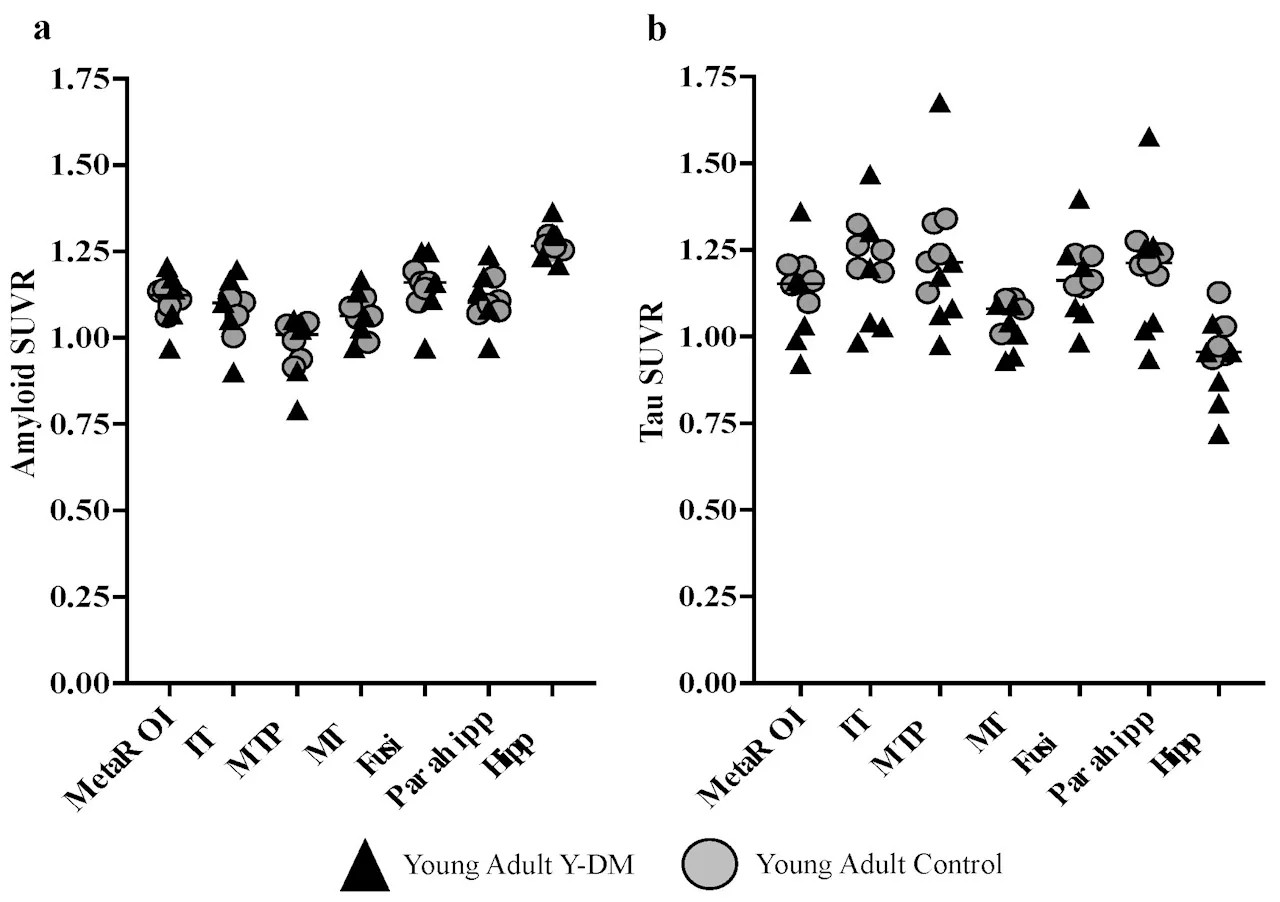 Diabetes in youth may increase risk for neurodegenerative disease, like Alzheimer's disease, later in lifeYoung people with diabetes may have a significantly higher risk of developing Alzheimer's disease later in life, according to a new study by researchers in the Lifecourse Epidemiology of Adiposity and Diabetes (LEAD) Center at the University of Colorado Anschutz Medical Campus.
Read more »