


New method identifies spatial biomarkers of Alzheimer's disease progression in animal model broadinstitute NatureComms
All images were obtained with a Leica TCS SP8 confocal microscope and with a 40× objective. The voxel size is 0.0946 × 0.0946 × 0.3463 μm. Propidium Iodide staining was applied according to the manufacturer’s protocol.
A detailed protocol of the experiment can be found in the STARmap PLUS paperWe used 3D chromatin images to obtain nuclear features and associated these features to plaque size using the regression gradient. The python package py-clesperanto of CLIJ was used for the 3D segmentation of chromatin images . For each cell, we used all the z-stack images and cropped the horizontal directions to 37.84 × 37.84 µmcentered at the cell centroid. After min-max scaling to [0, 1], the 3D stack of each cell was further cropped to 18.92 × 18.92 µmin the horizontal directions. The images were resampled in the z-direction to have isotropic voxels. Then we applied Gaussian blur, spot detection, a second Gaussian blur with sigma set to 3, Otsu thresholding, and Voronoi labeling. The first Gaussian blur was optimized with two iterative searches to obtain the maximum sigma value for which a cell can be detected at the given centroid. We used “binary_fill_holes” in the SciPy package with a 2 × 2 × 3 matrix of ones as the structuring element on the resulting mask after Voronoi labelingWe trained a fully connected network with three hidden layers of size 1024 to predict the size of plaque near a cell given the cell’s latent representation. The input was either the joint latent representation as described previously or an image-only latent representation by training an image autoencoder independently of the graph autoencoder latent space. The image autoencoder used for computing the joint latent representation and the image autoencoder used for computing the image-only latent representation have the same architecture. An image patch size of 75.68 × 75.68 µmwas used for training the autoencoders, which takes into account a neighborhood size comparable to the 20-nearest-neighbor cell adjacency used in the graph autoencoder. All regression models were trained with cells in: cluster 1; cluster 3; or both cluster 1 and cluster 3. For training the regression model, we either used both 13-month samples or only the 13-month AD sample without the control. Descriptions for all models together with the corresponding classification errors can be found in Supplementary DataPlaque images were preprocessed by setting an intensity threshold of 10 to filter out noise, applying Gaussian blur with sigma of 10, a second intensity threshold of 100, and a minimum size filter of 1111 pixels . A cell was labeled as positive if there was plaque within the 75.68 × 75.68 µmimage patch centered at the cell and it was labeled as negative otherwise. The hidden layers used leaky ReLU activationand a dropout rate of 0.5. The output layer used ReLU activation because plaque size is non-negative. The output is a positive prediction if the output value is larger than 1111 pixels. 15% of randomly selected cells in each training tissue sample were held out for validation and testing. We chose the training epoch that resulted in approximately equal true positive rate and true negative rate based on the validation set (Supplementary Fig.
United Kingdom Latest News, United Kingdom Headlines
Similar News:You can also read news stories similar to this one that we have collected from other news sources.
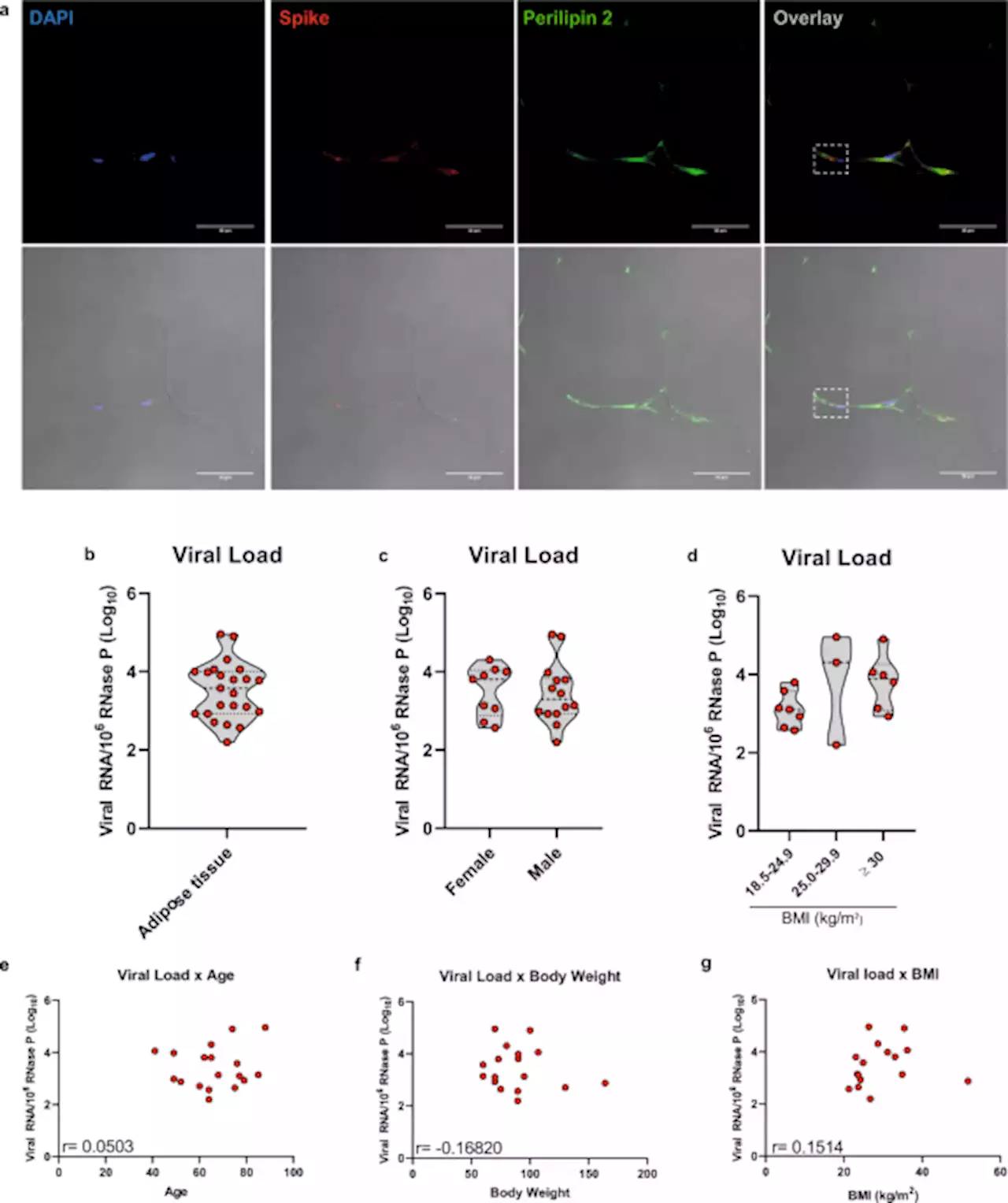 SARS-CoV-2 infects adipose tissue in a fat depot- and viral lineage-dependent manner - Nature CommunicationsVisceral adiposity is a risk factor for severe COVID-19, and infection of adipose tissue by SARS-CoV-2 has been reported. Here the authors confirm that human adipose tissue is a possible site for SARS-CoV-2 infection, but the degree of adipose tissue infection and the way adipocytes respond to the virus depend on the adipose tissue depot and the viral strain.
Read more »
 Dark-field chest X-ray imaging for the assessment of COVID-19-pneumonia - Communications MedicineFrank, Gassert et al. use dark-field chest X-ray imaging to assess COVID-19-pneumonia. Dark-field imaging has a higher sensitivity for COVID-19-pneumonia than attenuation-based imaging and provides an ultralow dose alternative to computed tomography imaging for that purpose.
Read more »
 Enterotoxigenic Escherichia coli heat-labile toxin drives enteropathic changes in small intestinal epithelia - Nature CommunicationsEnterotoxigenic Escherichia coli infections have been linked to non-diarrheal sequelae however, the reasons for this are unclear. Here, the authors present an additional role of heat-labile toxin in disrupting the structure and function of intestinal epithelial cells.
Read more »
 Genetic diversity fuels gene discovery for tobacco and alcohol use - NatureA multi-ancestry meta-regression study analyses diverse genome-wide association studies and genome loci associated with tobacco and alcohol use.
Read more »
 Use of a glycomics array to establish the anti-carbohydrate antibody repertoire in type 1 diabetes - Nature CommunicationsType I diabetes is characterized by autoantibodies directed against protein or non-protein self-antigens. Here the authors profile glycan reactive anti-carbohydrate antibodies (ACA) in a longitudinal and cross-sectional childhood diabetes cohort and associate clusters of ACA with disease progression.
Read more »
 Human visual consciousness involves large scale cortical and subcortical networks independent of task report and eye movement activity - Nature CommunicationsIsolating the neural mechanisms of consciousness is complicated by task report and other irrelevant signals. Here, the authors removed report and eye movement confounds to uncover large scale cortical-subcortical networks specific for human visual consciousness.
Read more »